Results
All numbers are on the human-labeled dataset of 4,420 sentences (3,094 train / 442 validation / 884 test). Test results were produced once per model, after every choice was fixed. Raw files are in artifacts/metrics/.
Headline
| Model | Trained on | Validation macro-F1 | Test macro-F1 | Test accuracy |
|---|---|---|---|---|
| TF-IDF + LinearSVC | synthetic data only | 0.6002 | not run | not run |
TF-IDF + LinearSVC (baseline_natural) |
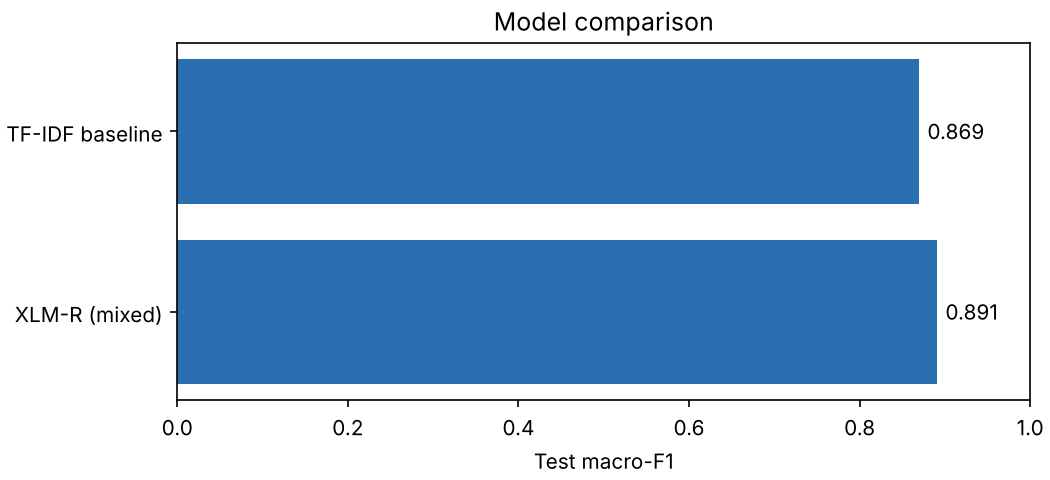
human-labeled | 0.8665 | 0.8695 | 0.8688 |
| XLM-RoBERTa base | human-labeled | 0.8663 | not run | not run |
XLM-RoBERTa base (xlmr_mixed) |
up to 30,000 synthetic + human-labeled (x5) | 0.8872 | 0.8906 | 0.8903 |
Is XLM-R really better?
Not demonstrably. On the 884 test sentences both models were right on 712 and wrong on 41. The baseline alone was wrong on 75, XLM-R alone on 56. The exact McNemar test gives p = 0.1155.
| Accuracy | 95% interval | |
|---|---|---|
baseline_natural |
0.8688 | 0.845 to 0.889 |
xlmr_mixed |
0.8903 | 0.868 to 0.909 |
The intervals overlap heavily. See Evaluation method.
Per class (test)
| Class | XLM-R precision | recall | F1 | Baseline precision | recall | F1 | Support |
|---|---|---|---|---|---|---|---|
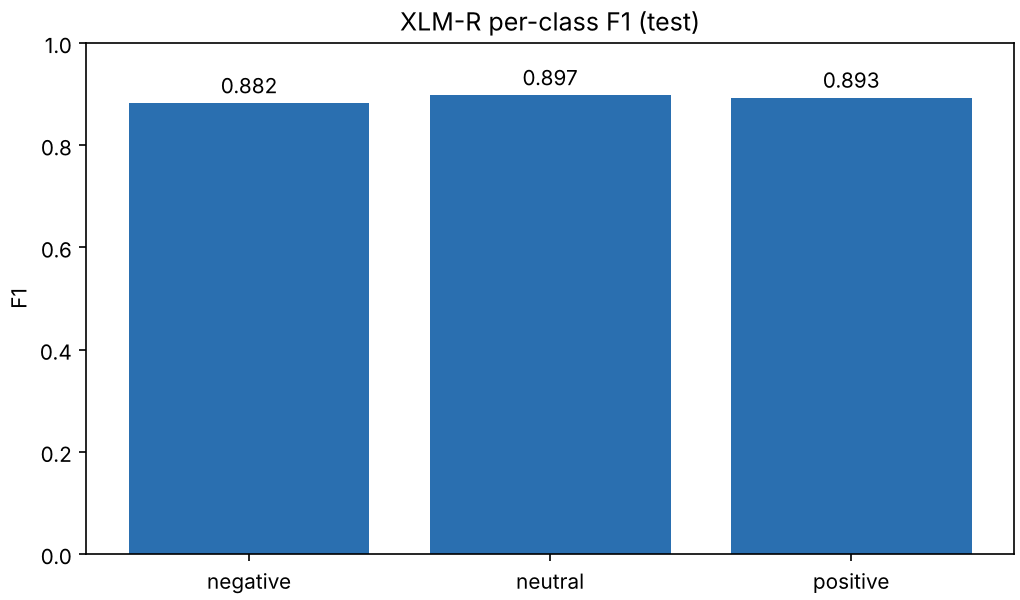
| negative | 0.858 | 0.907 | 0.882 | 0.853 | 0.853 | 0.853 | 300 |
| neutral | 0.935 | 0.863 | 0.897 | 0.912 | 0.880 | 0.896 | 284 |
| positive | 0.885 | 0.900 | 0.893 | 0.845 | 0.873 | 0.859 | 300 |
Where the mistakes are
Confusion matrices (rows = true class, columns = predicted class):
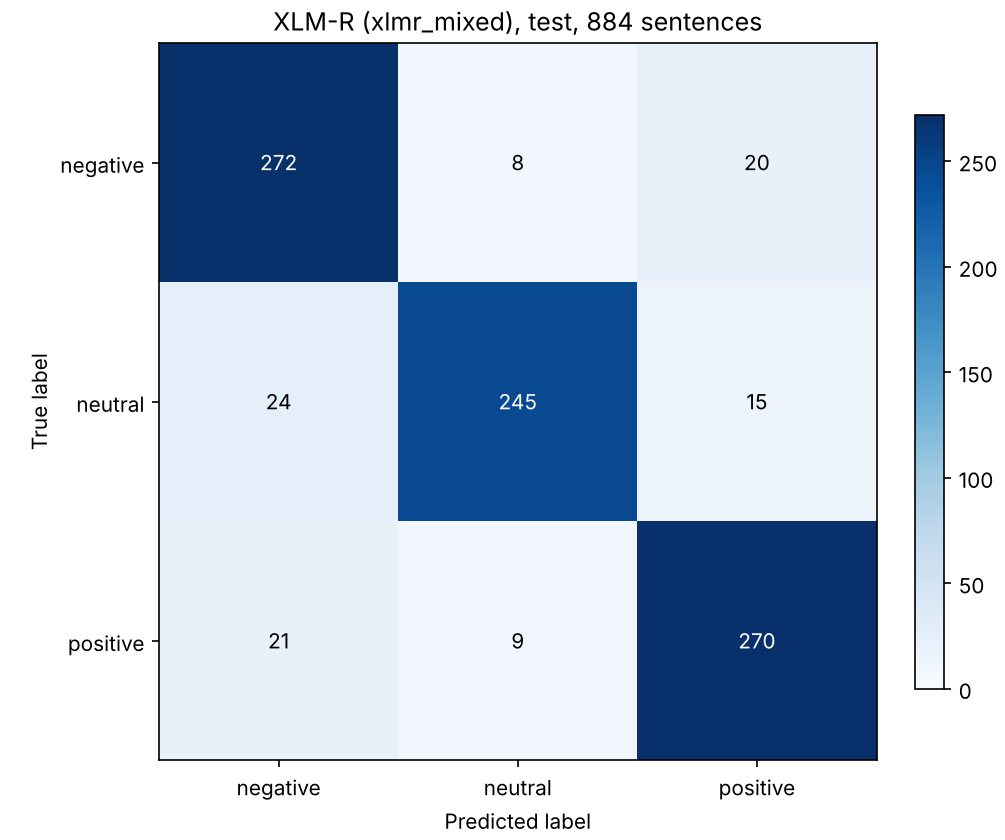
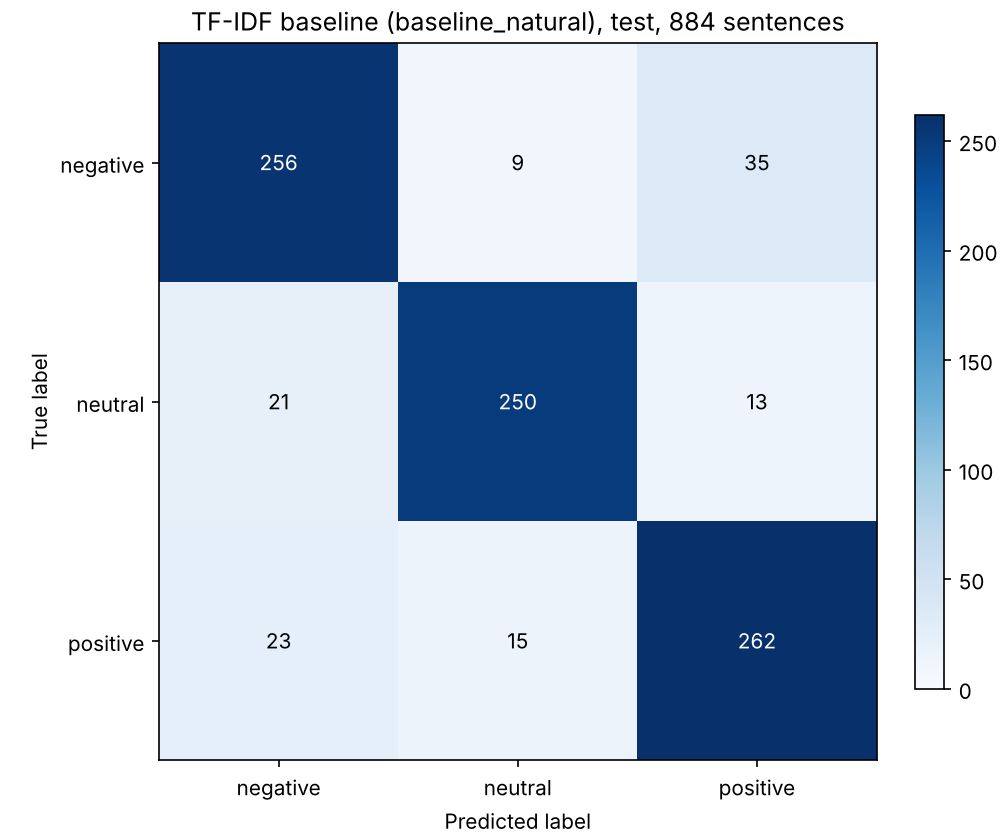
- XLM-R's mistakes are spread fairly evenly: 24 neutral sentences predicted negative, 21 positive predicted negative, 20 negative predicted positive, 15 neutral predicted positive, 9 positive predicted neutral and 8 negative predicted neutral.
- The baseline's largest single confusion is 35 negative sentences predicted positive.
- XLM-R's neutral predictions are the most precise (0.935) but its neutral recall is the lowest of its three classes (0.863): when it says neutral it is usually right, but it misses some neutral sentences.
What the synthetic data did
| Experiment | Validation macro-F1 |
|---|---|
| baseline trained on synthetic only, scored on human-labeled data | 0.6002 |
| baseline trained on synthetic only, scored on synthetic data | 0.9998 |
| XLM-R on human-labeled data only | 0.8663 |
| XLM-R on human-labeled + synthetic | 0.8872 |
Templated data teaches little about real text. Adding it raised XLM-R's validation score by about 0.02, a gap that was not tested for significance.
Reproduce
python -m sindhi_nlp.evaluation.evaluate_external --model-dir artifacts/models/xlmr_mixed --split validation
python -m sindhi_nlp.evaluation.evaluate_external --model-dir artifacts/models/xlmr_mixed --split test --final
python -m sindhi_nlp.evaluation.compare_models --a baseline_natural --b xlmr_mixed --split test
This needs the splits and model folders (not stored in Git); the reproduction steps and the dataset page explain how to obtain them. The figures above were generated from the saved metrics files with sindhi_nlp.evaluation.plots.